
– by Neria Harish Hebbar, MD
The history and the organization of the eight monasteries (called Ashta-Matts) in Udupi, Karnataka established by Sri Madhvacharya are interesting. It is perhaps one of the rare Hindu religious centers where the customs and routines as practiced by its founder have not been altered significantly for over seven centuries. Madhvacharya in late 13th century established the Krishna temple and the eight monasteries in Udupi. For seven centuries the monasteries have served as the bastions of Vaishnavism in India. It is one of the most sacred temples which boasts of many legendary saints, swamis as well as devotees. The monasteries have upheld the Dvaita (dualism) philosophy as proposed by Madhvacharya. Dvaita is Acharya Madhva’s interpretation of Upanishads and is incorporated in the philosophical branch of Darshana literature called Vedanta (end of Vedas).
Madhva was born in a village called Pajaka (Belle Grama) near Udupi. He was a prodigy who mastered Sanskrit and the Vedas at an early age and with the help of his guru Achutaprajna, amassed a wealth of knowledge from the Upanishads. Guru Achutaprajna was a proponent of monism (Advaita) of and tried to indoctrinate young Madhva into that philosophy. However, Madhva from his observations formed his own opinions after an intense study of the Upanishads. Eventually he even convinced his guru to abandon Shankara’s theory of monism and adopt the dualistic theory of Dvaita.
Guru Achutaprajna gave Madhva the name Purnaprajna after he completed and mastered the Vedas. Later he coronated (pattabhisheka) Madhva as a sanyasin and gave him the title Ananda Thirtha.
Acharya Madhva traveled the length and breadth of India to propagate his theory of dualism and won many disciples. There is a reference to one of his travels to North India when he was stopped by the Muslim rulers of Delhi. It is thought to be either Alauddin Khilji or Balban. Anyway, Madhva convinced the Muslim ruler that humans are children of the same God (Vishwakutumba). Impressed, the Sultan offered land and other amenities to Madhva, which he promptly refused. He asked for safe passage to Badrinath along with his disciples and the Sultan granted this.
Acharya Madhva not only was well versed in Vedas but also of the opinion that a healthy body was essential for a sound mind. He encouraged his disciples to exercise and build a strong body. He was also an ardent fan of wrestling. Acharya Madhva’s talents did not end there. He was a student of music and is considered to be the father of Carnatic music. He was a renowned singer of classical music. There are reports of him singing to a spellbound audience. Udupi, a part of Karnataka, was the hub of music because of Madhvacharya’s interest. Later this type of music spread all over South India and came to be known as Carnatic music (originated in Karnataka.)
Acharya Madhva was also interested in dance and drama. The unique indigenous folk dance called Yakshagana (a dance drama usually glorifying Indian mythology) is now thought to be the precursor of some of the well-known South Indian dances like Kuchipudi. Yakshagana was the medium created by Madhvacharya for the consumption of ordinary folks who were not well versed in the scriptures. He used this medium to educate the masses in spirituality. His disciple, Narahari Thirtha of Adumaru Matt was also instrumental in bringing this art to the forefront.
Yet the art of Yakshagana has moved away from Udupi, its birthplace, and has its base elsewhere in Tulu nadu today. A lack of support from the subsequent swamis of Udupi is blamed for this.
The Monasteries (Matts) :
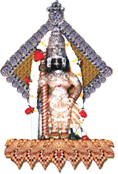
Madhvacharya established the Krishna temple of Udupi. The temple was built according to vastu shilpa. The idol was established facing west, which was a common practice at that time. (This was because the archaka can face east while performing puja. In temples where the idol faces east, the archaka is seen facing north, as he should never face west.) The idol could either be facing east or west, and both were acceptable according to Agama Shastra. This takes an important meaning, as we will see later as an urban legend tells the tale of devotee Kanakadasa, on whose account the idol of Krishna turned around 180 degrees so that the devotee could see Krishna’s face.
Acharya Madhva established the eight Tulu monasteries (Matts) in Udupi. The Matts were named in accordance with the names of the near by villages where they had the most assets. Thus Palimaru, Adumaru, Krishnapura, Puttige, Shiruru, Sode, Kaniyuru and Pejavara Matts came to be known as the Ashta-Matts of Udupi. Over centuries these monasteries upheld Madhva’s dualistic theory called Dvaita, which forms the basis of Hindu majority belief today. Uniquely, all the eight Matts are headquartered around the temple with their own buildings.
Sri Madhvacharya indoctrinated the eight disciples as swamis first. Later, when they were proficient in Vedanta, they were coronated (pattabhisheka) as heads of the eight Matts. In addition, he had a ninth disciple who did not have his headquarters in Udupi but was established over the Western Ghats. However, this Matt was closely aligned with Adumaru Matt. There is also close association between Udupi Matts and other nearby Matts. Subramanya Matt, Bhandarakeri Matt in Barkur and Bhimnakatte Matt in Thirthalli also belong to the Tulu family of Matts. Palimaru Matt and the well-known Matt in Gokarna (in Uttara Kannada; it is the gurupeeta for the Gowda Saraswat Brahmin society) are also considered as sister Matts.
When the swamis were coronated and placed on their thrones as heads of the various Matts, a suffix of ‘Thirtha’ was added to their names. Thus Hrishikesha Thirtha was the head of Palimaru Matt. He was the first disciple of Acharya to be coronated. The eight Matts are in this order:
- Sri Hrishikesha Thirtha of Palimaru
- Sri Nrisimha Thirtha of Adumaru
- Sri Janardhana Thirtha of Krishnapura
- Sri Upaendra Thirtha of Puttige
- Sri Vamana Thirtha of Shiruru
- Sri Vishnu Thirtha of Sode
- Sri Rama Thirtha of Kaniyuru
- Sri Adhokshaja Thirtha of Pejavara
The ninth Matt was headed by Sri Padmanabha Thirtha and is called Deshastha Matt. Each one of these Matts was also assigned a deity, but only four forms of Vishnu were chosen. They are Rama, Narasimha, Varaha, and Krishna (or Vittala). Each one of these deities represents the first syllable of the sacred ‘AUM’ (or OM that has four distinct sounds).
During Acharya Madhva’s time the organization of the Matts was slightly different than now. There were three swamis in each Matt. The oldest swami, on the verge of retirement was not involved in the administration of the Matt’s affairs. Instead, he concentrated on teaching the youngest trainee swami as well as spent his time in meditation. The younger swami was in charge of the daily affairs of the Matt as well as performed other obligatory functions for the spiritual uplift of the society in general. The youngest swami was usually a mere boy, being indoctrinated to ascend to the higher position. His training was the responsibility of the elder swami.
There was no rule that the swami had to be a bachelor. Even a married man could be chosen as the swami as long as he had renounced the worldly affairs and was willing to devote his life in the service of Lord Krishna.
Many palm leaf scrolls belonging to 14th century onwards are preserved in various Matts in Udupi. They are both in the Kannada and Tulu scripts. Many have been lost because of poor preservation technique. Some have made it to the modern print media and have been published. Many more need to be translated and published.
Literature:
Researcher Bannanje Govindacharya has had the privilege of seeing many of the preserved texts from the Matts. With his immense knowledge and interest, Govindacharya has an advantage, as he is proficient in Sanskrit, Kannada and Tulu scripts. He has been able to read the document that is in Palimaru Matt, written by none other than the first disciple of Acharya Madhva, Sri Hrishikesha Thirtha. The palm leaf scroll written in beautiful handwriting is the replication of his guru Madhvacharya’s works. The work had been read and blessed by Acharya Madhva himself. Two other creations called ‘Sampradaya Paddhati’ and ‘Anu Madhva Charite’ are also credited to this Hrishikesha Thirtha, though there is not enough proof for this.
There were many more historians, poets and Vedantis amongst the many Swamis of the eight Tulu Matts of Udupi. There is a wealth of literature that has been preserved. A scroll describing the method of attaining ‘sanyasa’, a sort of guidebook for would be renouncers of worldly affairs was written by Sri Vishnu Thirtha of Sode Matt. It is called ‘Sanyasa Paddhati’.
Another scholar was Sri Rajarajeshwara Thirtha of Palimaru Matt from the 14-15th century, who wrote several popular poems and bhajans. His creation ‘Ramasandesha’ is compared to Kalidasa’s writings.
Of course, the most well known of all the Swamis is Sri Vadiraja from Sode Matt from the 16th century. Many other scholars lived and administered in Udupi Matt and their works and names are too many to enumerate here.
Swami Vadiraja (1480-1600):
After Acharya Madhva the most well known figure in Udupi is Swami Vadiraja He took over as the head of Sode matt in early sixteenth century. He was a reformer and a visionary par excellence. Originally Sode Matt was called Kumbasi matt as the major assets of the Matt were in Kumbasi. Swami Vadiraja defeated the Virashaiva guru of the local king in Vedantic discursions and established his base in the village of Sode. Since then the Matt has been called Sode.
Swami Vadiraja was not only a scholar but also a poet. He wrote hundreds of critiques and treatises to Acharya Madhva’s works as well as works of other Swamis before him. He was also mindful of the common people who needed guidance and directions in their devotion to Lord Krishna. Bhajan was an important part of daily routines of Hindus. Swami Vadiraja gave them innumerable songs including the famous ‘Shobhane’, which is recited even today by women at dusk every day as part of their prayer routine.
Swami Vadiraja also was a pioneer in reforming the administration of the Matts as regards to their obligations towards the puja ritual of the temple. Previously, various heads of Matts were in charge of puja at Krishna temple for a period of two months at a stretch. He introduced the ceremony of Paryaya, when the designated Matt is in charge as overall administrators for a period of two years. The first Paryaya was held in the year 1522, when swami of Palimaru Matt took over as the overall administrator of the temple for a period of two years. Vadiraja (of Sode matt) himself became the head of Paryaya for the first time in 1532. The order of Paryaya was selected according to the order of the swamis being coronated by Madhvacharya (note the list above). In the year 1596, it was the turn of Sode Matt to take charge of Paryaya for the fifth time. Though Swami Vadiraja was alive at that time he let his younger disciple take over. Swami Vadiraja died in the year 1600 at the age of 120.
Today Paryaya ceremony in Udupi draws a global audience every two years. In the year 2000, a cycle of thirty Paryayas for each Matt was completed (478 years). In 2002, Palimaru swami took over to begin yet another cycle (31st).
Swami Vadiraja was also the builder of the famous Kanaka-na-kindi (Kanaka’s window) on the western wall of the temple, which had been devoid of windows. The swami restored the honor and dignity to Kanakadasa, who was an ardent devotee of Lord Krishna in Udupi.
Please accept my humble pranams.
Coming dasara holydays we are planning to visit the holy land of Udupi and we would lke to take darshan of Sri Madava charya’s birth place and about him. We are the followers of Brahma Madava Goudiya sampradya.( ISCKON). Your guidence in this regard will be considered asauthoratative.
Expecting guidence and advice.
Dandavats
Krsna Acyuta Das
Namaskara.
You are mentioned about ashta mathas…….can you please give the details about life before Guru Madwacharya at udupi or shivalli……..For your kind information………it was a Ashta Bhairava’s……in the middle Kala Bhairava is there( At present people call it as Anantheshwara)……Ashta matha is in the circle of Anantheshwara………not Krishna Math…..
I agree to all the story which you have told…But let us also give the story of before Guru Madwacharya.
Thanks
i just want to continue the discussion……….if anything wrong, please forgive me.
u have told in your article that, The Eight Tulu Monasteries of Udupi…it means tulu language is only 700 year old.!!!!!!!!!!! before that which language was there…even many people in tulunadu believe in sringeri also……..can we also include sringeri swamiji in this list…then it become 9……again, tulu people are not only the madwa followers,,,, there are tamils, kannadigas,etc…8 swamijis are not only limited to tulu or kannada………..we cant give wrong direction to young generation… Raghavendra swamiji was from tamilnadu………and he followed madwacharya…and his place at present is in andhra pradesh…………do u think only tulu people follow madwa philosophy.? can we atleast stop all these type of differences ? God dont see at languages, caste or money ..let us not give much importance to those differences.we should start prayer to save this sanathana dharma, instead of finding these differences and fighting between us..Tulunadu ruled by many people before madwacharya period also. and there were many saints lived here and they also contributed much on tulu or tulunadu…am not against to Madwa tathva. Am against to the present situation.
i will write again on this….am busy now
Divine website.
One of the greatest contributions of India to the world is Holy Gita which is considered to be one of the first revelations from God. The spiritual philosophy and management lessons in this holy book were brought in to light of the world by many great Indian saint’s effort and they call the Bhagavad-Gita the essence of Vedic Literature and a complete guide to practical life. It provides “all that is needed to raise the consciousness of man to the highest possible level.” Maharishi reveals the deep, universal truths of life that speak to the needs and aspirations of everyone. Your followers in your establishment continuing the mission by keeping this lantern burning always knowing the wishes of the modern generations. Arjuna got mentally depressed when he saw his relatives with whom he has to fight.( Mental health has become a major international public health concern now). To motivate him the Bhagavad-Gita is preached in the battle field Kurukshetra by Lord Krishna to Arjuna as counseling to do his duty while multitudes of men stood by waiting. Arjuna face the problem of onflict between emotions and intellect . In almost all of the cases, emotions win. Only a very
few people have a conflict-free emotion and intellect. Emotions, are required, for, without them, one is a mere robot. They make life pleasant as long as they are sensible and within limits. It has got all the management tactics to achieve the mental equilibrium and to overcome any crisis situation. The Bhagavad-Gita can be experienced as a powerful catalyst for transformation. Bhagavad-Gita means song of the Spirit, song of the Lord. The Holy Gita has become a secret driving force behind the unfoldment of one’s life. In the days of doubt this divine book will support all spiritual searches. This divine book will contribute to self reflection, finer feeling and deepen one’s inner process. Then life in the world can become a real education—dynamic, full and joyful—no matter what the circumstance. May the wisdom of loving consciousness ever guide us on our journey? What makes the Holy Gita a practical psychology of transformation is that it offers us the tools to connect with our deepest intangible essence and we must learn to participate in the battle of life with right knowledge?. It shows us the path to handle the situation with equipoise mind irrespective of what comes our way and reminds us time and again, that what the right action is.
Indian Vedic contribution is a reservoir of Vibrant Information and Harmonious Creativity. May the Womb of Nature Embrace all with Tranquil Blessings from this day forward. Let this attract one’s attention affecting them Positively. It is a Sanctuary of the Self , a Creative Venue which serves as an Enduring Expression of Lightness, where a peaceful Atmosphere with Sunlight Flows and serene atmosphere prevail.
In the storm of life we struggle through myriads of stimuli of pressure, stress, and muti-problems that seek for a solution and answer. We are so suppressed by the routine of this every life style that most of us seem helpless. However, if we look closely to ancient techniques we shall discover the magnificent way to understand and realize the ones around us and mostly ourselves. If only we could stop for a moment and allow this to happen. May all beings be happy (Loka Samastha Sukhino Bhavanthu)
The ancient Hindu philosophy of keepiing mind and body for the well being, has entered the managerial, medical and judicial domain of the world. Today it has found its place as an alternative to the theory of modern management and also as a means to bring back the right path of peace and prosperity for the human beings. Let me bow to Indian Maharishi Veda Vysa with folded hands who helped in removing the impurities of the mind through his writings on Vedas, impurities of speech through his writings on puranas, and impurities of body through his writings on other sacred texts.
The Holy Gita is the essence of the Vedas, Upanishads. It is a universal scripture applicable to people of all temperaments and for all times. It is a book with sublime thoughts and practical instructions on Yoga, Devotion, Vedanta and Action. It is profound in thought and sublime in heights of vision. It brings peace and solace to souls that are afflicted by the three fires of mortal existence, namely, afflictions caused by one’s own body (disease etc), those caused by beings around one ( e.g. wild animals, snakes etc.), and those caused by the gods (natural disasters, earth-quakes, floods etc).
Mind can be one’s friend or enemy. Mind is the cause for both bondage and liberation. The word mind is derived from man to think and the word man derived from manu (Sanskrit word for man).
“The Supreme Lord is situated in everyone’s heart, O Arjuna, and is directing the wanderings of all living entities, who are seated as on a machine, made of the material energy.”
There is no theory to be internalized and applied in this psychology. Ancient practices spontaneously induce what each person needs as the individual and the universal coincide. The work proceeds through intellectual knowledge of the playing field ( jnana yoga), emotional devotion to the ideal (bhakti yoga) and right action that includes both feeling and knowledge (karma yoga). With ongoing purification we approach wisdom. The Bhagavad-Gita is a message addressed to each and every human individual to help him or her to solve the vexing problem of overcoming the present and progressing towards a bright future. Within its eighteen chapters is revealed a human drama. This is the experience of everyone in this world, the drama of the ascent of man from a state of utter dejection, sorrow and total breakdown and hopelessness to a state of perfect understanding, clarity, renewed strength and triumph. May the wisdom of loving consciousness ever guide us on our journey. What makes the Holy Gita a practical psychology of transformation is that it offers us the tools to connect with our deepest intangible essence, and we must learn to participate in the battle of life with right knowledge.
“Freed from attachment, fear and anger, absorbed in Me, and taking refuge in Me, purified by the penance of knowledge, many have attained union with My Being.” (Gita 4:10)
Mind is very restless, forceful and strong, O Krishna, it is more difficult to control the mind than to control the wind ~ Arjuna to Sri Krishna
Madhwacharya’s mother tongue was Tulu not Kannada .The initial followers of the madhwa philosophy were Tulu Madhwa Shivalli Brahmins. The Ashta mutts are Tulu Mutts and not Kannada Mutts.Even now Ashta Mutts Guruvaryas sign in Tulu script.
Its a matter of pride to say that Madhwacharya and Vadiraja Guruvarya were both Tulu Shivalli Brahmins.and according to HARISH MADHYASTHA shivalli brahmins site is not providing any wrong information.The website is just providing what is fact.There are also Kannada Madhwas and Kannada Madhwa mutts but that doesnt mean Entire madhwa community is Kannada.Its an Undisputed fact that Madhwacharya was Tulu Shivalli brahmin and Astha Mutts are Tulu Mutts ( including Kukke Subramanya/Bhandarakeri/Bhimanakatte). So info available on shivallibrahmins site is cent present correct
Narayana smaranams
Even before Sri Madhwacharya people of udupi used tulu language and Acharya madhwa’s family belonged to this sect. So that proves that tulu language is more than 700 years old. So that clears the doubt of Sri Harish Madhyastha’s about the time of the language. If some people of tulunadu follow sringeri mutt does that mean that the swamiji’s name can be included in Madhwa ASHTA MUTT. So it is better to know the fact before saying the site is misguiding youngsters. We cannot just keep adding different mutt swamiji’s names under an established mutt organisation. So please know the facts before commenting. Info on the site is perfectly correct .
Hi
Its unfortunate that we still keep arguing which language madhwa spoke…
that is not important at all…after a language orginated from sound…a lion understands lion’s roar,dog its barking…like that the languages have emerged and evolved with sounds and sylablles how people understand….
what is important is….have we understood madhwa philiospophy how much of it are you practicing, how much do you believe in it…that is what is important not if madhwa was a shivalli or a deshastha… for god sake stop this spread of regionalism if madhwa had been regional in nature, madhwa philospohy would have got restricted to udipi… will you please wake up….!!!!!
Hi
As praveen rao claims no one is arguing here.What madhvacharya spoke may not be important to others(kannada madhvas) but will surely matter to use because it(Tulu) is our mother tounge.What he taught has been carried to us from our ancestors not only in sanskrit but also in our mother tounge.So its our primary duty to safegaurd our mother tounge and sr madhvacharya’s teachings.And the question of how much one is practising again depends on our teaching to children.A small child may not understand sanskrit but will surely understand our mother tounge.So language is very important.This clearely shows all of us are awake
I fully agree with Sr Saralaya. The surname of Madwacharyas father is Nadillaya. This means Middle home in Tulu. Therae are surnames like Miththillaya Sirthillaya etc. These are typical Tulu words / surnames. Certainly ACharyas father and who knows his fore father also was speaking TULU. No doubt about this.
Good discussions, good comments. As i mentioned ealier, am not againsta madhwa thatva…even am a shivalli brahmin. …from udupi. why we shud limit sri acharya only for udupi. its wrong. even before Madhwacharya…there was tulu language. all these 36 families like Miththillaya Sirthillaya etc came from ahichathra brought by king mayura varma. that time it was followers of shiva. not vishnu. madhwa thathva may be right. madhwacharya might have experienced the god …are we doing that…or are we rightly following and trying the same experience. our ancestors may say many things. but it is not good to follow blindly. experiencing self will be good and we shuid even teach young generation towards that …instead to force them to follow the teaching as we recd. what is this tulu, kannada, tamil….etc….it doesnt matter about the language. it really matters the teachings. we dont get nobel prize by claiming wheather he is tulu or kannada. ultimately everybody shud experience like madhwacharya experienced the god.even sringeri mutt also established before that. not onlu udupi ashta mutt. why we need to only follow the rules which is just 700 years. we even get history of more than 2000 yrs.
udupi also situated in this earth. it is not the only place … guru shud be changed everytime. no need to go behind the same guru. we may come across with many gurus in our life. ultimate will be self experience. our 5th std teacher will not come along with us to teach at 10th std, the same way 10th std teacher will never come to teach in degree. same way we need to change our guru everytime we finish respective subject. guru is not a body oriented. it is knowledge oriented. teacher may come and go. but guru or knowledge is permanent.sicence teacher may go away. but science is permanent. so let us stop giving wrong direction to young generation plzzzzzzzzzzzzzzzzzzzzzzzzzzzzzzzz.
Name of Sri Madhvacharya was Vasudeva Bhat in poorvashram, Sri Poornaprajna Thirtha Swamiji at initiation of Sanyas, and Sri Ananda Thirtha Swamiji upon winning a debate. But He kept His Kavya nama as ” MADHVA” .
What is meant by Madhva?
What is meaning of Madhva in tulu ?
Tulu is not the name of a language and it is is not a proto dravidian language but it is the name of the frontier of a land which is called as tulu nadu. It extended till mysore and even the vijayanagara kings were called as tuluva kings. TULU word means the characteristics of the soil which means that which is very loose and mixed with slime as you dig down so even sakaleshpura is inside tulu nadu and many epigraphicas are found over there written in a scipt which is tigalari script. The parashu rama kshetra which was under sea came up many eons ago and joined with the land called as tulu nadu and the whole land mass was called as tulu nadu. This piece of land was under pallavas then the pandyas and the cholas ans also the cheras.and the centre for administration for pandya was barkoor and thus he appointed his officials over there called as sthanikas who were the original tulunadu brahmins and the language which is spoken of here along with kannada is old tamil [pala tamil] which is now named as tulu language after 18’th century. The script was originally Grantha lipi which is alos called as tigalari lipi and it became aryaelatthu and that became the basis for malayalam and the pala tamil.e tulu language by going changes called as moodiyaku also called as modiyar in tulu it is called as modiapuna which is havig its own rules and regulations which which is not known in dakshina kannada so that was called misappropriately as an independent original language as tulu after 18’th century. I’am an historian and linguistic in tamil language who has done phd in tamil and pala tami and historyfrom Annamalai university and know all the kannada, tamil,telugu, malayalam scripts . You people go and see the pala tamil manuscripts in libraries of tamilnadu they are what you call as tulu here. See the similarities
TAMIL PALATAMIL/TULU
PENNU PONJOVU
PAGAL PAGEL
SANGATI THANGATI
CHOLLU SOLLU
UIYOORU USIR
UDAL TUDAR
PORATA HORATA
If you people come to tamil nad we can easily understand your pala tamil /i.e tulu and you can also easily nderstand tamil
Thank you
Shankaranarayana -VADAPALANI
HISTORIAN AND LINGUISTIC
The relation of tamil; pala tamil-tulu ;and hale gannada ; can be known properly by studying TOLKAPPIYAM a book on old tamil grammar
Wha tHarish madyastha has told is Very much correct.
Before 700 years the Ananthaeshwara temple which is a Veda samhita abhisheka linga was in the hands of shaivites called as Sthanika tulu Brahmins who are the original smartha brahmins /tulu brahmins & the oldest brahmins of tulu nadu the frontiers of which extended even uptil madurai.They were the followers of Dakshina Aamnaya jagadguru sringeri peetam. There was also an Venu Gopala krishna consecrated by Hastaamalakacharya the sishya of Aadi Shankaracharya in the same place which was removed to kongur;near malpe.
Due to skrimishes between sthanikas and shivallis over the matter of of a pond and many other filmsy fights during Vadiraja time the the sthanikas were Forciblly thrown out of the temple Archana and Tantra agama.
http://www.udupitourism.com/Udupi
It is learnt that Sri Madhwacharya installed Sri Krishna Idol in middle of Mooda Nidambur Village. Sri Vadiraja Thirtha Swamiji purchased land along with 2 Shiva temples from Smartha (SWARTHA) Shivalli Brahmins and installed Idol at present location.
Umesh ji
Please do not write false information. The link which you gave, does not support your claim. Sri Madhwacharyaru installed Sri Krishna idol in the present location itself. Further, what is your intention of calling smartha brahmins as “swartha” brahmins? Are they synonyms?
http://nitaaiveda.com/All_Scriptures_By_Acharyas/Biographical_Works/The_Life_and_Legacy_of_Madhvacharya_Bhagavatapada/AFTER_THE_DISAPPEARANCE_OF_MADHVA.htm
Dear Sir, It is a matter of concern if one sells his own God for material benefits. From the link I provided in my last comment one will definitely think once about shifting of the Idol while he knows about Mooda Nidamboor village layout.
My intention was not to hurt feelings of anybody but to bring the facts open, I am sorry if I Hurt feelings of any person.
Dear readers
please get your facts right before commenting .You say Vadiraja is a Sanyasi .Material ways of the world are not for them. From where does a sanyasi gets money to purchase lands .A sanyasi has done ghata shradha[his own shraddha] then what is the use of land to him.During vijayanagara rule temples were not just religious centres but centres for administration[as we call offices like panchayat,parishad, vidhan soudha,high court, university etc in todays parlance ] .How can anybody sell such officies.
If we talk regarding nittoor & nidamboor many things will come out and what vadiraja has done to sthanika tulu brahmins will be very bad conclusion to recocile.
Dear Sir, twin temples of Udupi were earlier called as Moodana Deva and Paduvana Deva. They were called as Chandramaulishwar and and Anantheshwar only since 17th century just to suit them to Rajathapeetadhishwar of Pandith Narayanacharya in Madhva Vijaya. http://www.udupitourism.com/Udupi
https://en.m.wikipedia.org/wiki/Kallianpur
Uppoor was believed to be birth place of Sri Madhwacharya. This might be true in the light of reconstruction of a Swamutt with ANANTHASANA (Ugra Narasimha) as main dirty (once fully destroyed by Tippu) by H.H.Sri Sri Vidyavallabha Thirtha Swamiji of Kaniyoor Mutt.
https://en.m.wikipedia.org/wiki/Kallianpur
Uppoor was believed to be birth place of Sri Madhwacharya. This might be true in the light of reconstruction of a Swamutt with ANANTHASANA (Ugra Narasimha) as main dirty at Kukde Harady Bhadragiri Brahmavar (once fully destroyed by Tippu) by H.H.Sri Sri Vidyavallabha Thirtha Swamiji of Kaniyoor Mutt
Sorry there was typographical error as to Deity.
Sir;
Do you really believe all the things mentioned in udupitourism.com. Adi shankaracharya was at rajatapeetapura and he did the pratistapana of chandramouleeshwara and that is mentioned in all shankara vijayas . The names mentioned in the inscriptons are indicating the direction of the temples that one which is towards east is mahadeva [now called as ananthaeswara] and the one towards west is adi shankaracharya pratistapita chandramouleeshwara. This type of insciptions during 17’th century was common to remove confusions as two shiva temples were at the same place. Hastamalakacharya did Venugopal krishna pratistapana [enne krishna] in the now krishna mutt premises which is now in kongur matt
https://groups.google.com/forum/m/#!msg/trawelindia/s0NiObelwRc/6XfJdJSYP-cJ
Dear Sir,
Story of king Rambhoja and Rajathapeet was a mythical story in Skanda Purana and there is no historic evidence for it. Such mythical stories are being used by different people to suit their location, like Parashuram bringing Brahmins from Ahicchatra, Lord Ganapathi cheating Ravana while going with Atmalinga.
Further two temples were not established by Sri Shankaracharya but were converted to temples by Him .
http://thiyyahistory.blogspot.in/2012/11/normal-0-false-false-false-en-in-x-none.html
Dear Sir, Story of 32 gramas in Kerala.
During my South India tour by Nirmals Travels ,I visited one place where a lord Shiva Temple is on a small hill and statue of Lord Ganapathi ( top on head of statue there is Mark of a blow) at foot of the hill. We were narrated story of Bhookailas as is being linked to Gokarna.
In this way mythical stories do not have historical background and are being used by different people to suit their locality.
http://aumamen.com/story/story-of-hastamalaka
Where from Sri Hastamalak hailed in 9th century ? Shivalli ?
https://hemaspiritualpoetry.wordpress.com/2014/08/10/adi-shankara-and-hastamalaka/
Where from Sri Hastamalak hailed ? From BAALLI near Gokarna next to Karwar ?
Aadi Shankaracharya didn’t convert anything.Keep one thing in mind that bhuddism and advaita is having no difference as far as theology is concerned only the difference is in yagna karmas and shoonya vada. There is no inscription which states that there was a buddha vihara in rajatapeetapura.
Hastamalakacharya was in8;th century.
The idol which you are seeing today is of dandayudhapani and not krishna according to shipa shastra and the original venugopala krishna- enne krishna is in kongurmata near malpe.
First read history in scientific way
https://archive.org/details/AncientKarnatakaVol.I.HistoryOfTuluva
Dear Sir,
Please go through pages 374 onwards
Please go through
http://www.kamakotimandali.com/blog/index.php?p=1360&more=1&c=1&tb=1&pb=1
The knowers of Shilpa śāstra suggest that the idol of Kṛṣṇa in the shrine at Udupi does not confirm to the lakṣaṇas laid out in the āgamas for an idol of Viṣṇu or Kṛṣṇa. The idol, according to some experts of iconography, is of Skanda or Subrahmanya.
According to popular belief, this idol was originally from the fabled city of Dvārakā and was obtained by Madhvācārya through a sailor. The idol, known to have been covered with gopīcandana, was consecrated and installed in the shrine at Udupi by Madhvācārya, the founder of Dvaita Vedānta.
There is also the popular tale of Kanakadāsa, pleased with whose devotion, the idol is said to have turned towards the western direction within the shrine at Udupi. But it is now pointed out that the consecration of the original idol was done facing the west and that the tale of Kanakadāsa probably was created during the time (fifteenth century) of prominence of the Kuruba community (shepherds) to which Kanakadāsa belonged. As the idol arrived from the sea which faces the west, it is said to have been consecrated facing the same direction.
This controversy is nothing new, but seems to have gained a new momentum due to discussions on digital and social mediums. Many of the points outlined below are recorded in a Kannada book published by the Indian Archaeological Society named – ‘Udupi: Itihasa and Puratattva’. A researcher and writer named Manjeshwara Mukunda Prabhu has spent more than a decade investigating this subject and has collected various opinions from different research scholars which indicate that the idol is indeed of Subrahmaṇya and not Kṛṣṇa. He published an article for the first time in 1985 with his study which had then created a big controversy. Some of the noted scholars who have studied the idol and its history in depth and conclusively opine that it is indeed an idol of Skanda are:
– Dr. G N Panth, Director, National Museum, New Delhi
– Dr. R C Sharma, Director, Indian Museum, Calcutta
– T V G Shastri, Director, Birla Archaeological and Cultural Research Center, Hyderabad
– Dr V V Krishna Shastri, Director, Government Museum, Mangalore
– Thiru N Harinarayana, Director and Research Scholar, Government Museum, Hyderabad
All these reputed scholars have published their studies supplemented by verifiable proof. P Gururaja Bhatt, in his book, Studies in Tuluva History and Culture (page 331), notes: ‘the absence of kirīṭa is another feature and owing to the impact of age, the face is worn out”. He posits that the idol is much older than the time of Madhvācārya with several interesting implications.
Following are some of the key arguments put forth by these various scholars.
Udupi was originally a śaiva kṣetra
Researchers are of the opinion that Udupi, to begin with, was a śaiva kṣetra. The place gets its name ‘Udupi’ after Chandra (moon) – (Udu+pa = nakṣatrādhipati) who is said to have performed a penance here to please śiva to rid himself of leprosy which he contracted due to a curse from Dakṣa prajāpati. Lord Shiva is said to have appeared here to Chandra, cured him of his affliction and worn him as an ornament, thereby appearing as Chandramaulīśvara. Two ancient temples in Udupi are of Ananteśvara and Chandramaulīśvara. Shivalli, a place near Udupi (known for Sthanika Brahmins) was a famous center of śaiva worship before the time of Madhvācārya. There are references available today that speak of four shrines dedicated to śakti and to Skanda in four directions surrounding the temple of Ananteśvara. Of these, one of the temples of Skanda is missing today, and as recorded in an issue of the Archaeological Gazette of India, the current temple of Kṛṣṇa is known to originally have been this now missing shrine of Skanda.
Iconography of Kṛṣṇa and Skanda idols
It is pointed out that the pose of the idol holding what is alleged to be a churning rod in one hand, with his other hand on his waist – is not associated with idols of Kṛṣṇa and such an idol is not seen elsewhere in India.
(a) The idol sporting a daṇḍa in one hand, is stationed in the heroic pose of ekabhaṅgi or samabhaṅgi (a straight posture with no bends) rather than the tribhaṅgi (three bends of the body at the waist, neck and the knee) which is commonly associated with idols of Kṛṣṇa. Even the aṣṭottara used in the temple of Kṛṣṇa today includes the name: tribhaṅgine namaḥ. Various forms of Kṛṣṇa such as Nartana Kṛṣṇa (dancing posture), Govardhanadhāra (lifting mount Govardhana), Kāliṅgamardana – none of these are seen in samabhaṅgi.
(b) The chief object associated with the idol of Kṛṣṇa is the flute which is also missing in the idol at Udupi. The iconographical details hence seem to match those of Subrahmaṇya instead who is frequently depicted as Daṇḍāyudhapāṇi (bearing a staff in his hand).
(c) According to āgama and shilpa śāstras, some of the common characteristics of an idol or icon of Kṛṣṇa are: śaṅkha and cakra, mukuṭa (crown), peacock feather, vanamālā, śrīvatsa lāñchana, pītāmbara (the idol in Udupi on the other hand is clad in kaupīna – associated with Skanda) and flute. Now, the reasons why this idol is that of Skanda are: samabhaṅgi (discussed earlier), daṇḍāyudha in the hand, kaṭihasta (hand on the waist), kaupīna (loin cloth) and keśālaṅkāra (as opposed to hair covered by a crown in the case of Kṛṣṇa vigrahas).
The idol at Udupi perfectly fits the below popular pratimā lakṣaṇa of a Skanda vigraha from Kumara Tantra:
कल्पद्रुमं प्रणमतां कमलारुणाभं
स्कन्दं भुजद्वयमनामयमेकवक्त्रम् |
कात्यायनीसुतमहं कटिबद्धदाम-
कौपीनदण्डधरदक्षिणहस्तमीडे ||
kalpadrumaṃ praṇamatāṃ kamalāruṇābhaṃ
skandaṃ bhujadvayamanāmayamekavaktram |
kātyāyanīsutamahaṃ kaṭibaddhadāma-
kaupīnadaṇḍadharadakṣiṇahastamīḍe ||
Another similar verse can be seen from the ancient Kāmikāgama:
द्विहस्तो यज्ञसूत्राढ्यः सशिखस्त्रिमेखलः |
कौपीनदण्डधृक् सव्यपाणः कट्याश्रितो अपरः ||
dvihasto yajñasūtrāḍhyaḥ saśikhastrimekhalaḥ |
kaupīnadaṇḍadhṛk savyapāṇḥ kaṭyāśrito aparaḥ ||
Agencies associated with the Kṛṣṇa Maṭha of Udupi deny this theory and insist that the idol follows the guidelines of the work Tantrasārasaṃgraha of Madhvācārya and hence argue that it is no big deal if it defies the well-known rules of āgama and śilpaśāstra. However, this argument makes no sense as the idol (according to the narrative of the Mādhva votaries themselves) existed much before the birth of Madhvācārya, and hence also predates the work Tantrasārasaṃgraha. The very first reference to a churning rod (in the hands of this idol of Kṛṣṇa ) seems to have started from the time of Vādirāja (1480), a Mādhva Yati who first interpreted the daṇḍa as a churning-rod and the channavīta.
Dr. Selvapillai Iyengar, who has a doctorate in śilpaśāstra and is currently serving as a research scholar at KSOU, asks the following questions:
(a) Kṛṣṇa is generally depicted as wearing an urudāma (a thread around the waist or hip, which most traditional Hindus wear to this day), but never holding a rope in his left hand.
(b) Even if the idol did depict a rope, why is it held in left hand and not tied to the churning rod?
(c) Why is the churning rod, if it indeed was one, held in an inverted fashion with the churning end pointed upwards?
Subrahmanya worship in Dakshina Kannada
The idol said to be of Balarāma which also was retreived by Madhvācārya from the ship and installed at Vaḍabhāṇḍeśvara, is again very similar to the idol of Skanda and does not confirm to any lakṣaṇas of an icon of Balarāma. Both idols, researchers opine, are of Skanda and resemble numerous such idols found throughout the region of Dakshina Kannada where the worship of Subrahmaṇya was very popular in the past. Shown below is one such image of Skanda which closely resembles the idol in Udupi alleged to be a Kṛṣṇa vigraha.
This article has lot of false information
In the article it is mentioned as Madvacharya is the father of Yakshagana.
The Yakhagana is founded by Parthi Subbayya for sure and not Madwacharya. Please refer to the below link: http://www.yakshagana.com/Profile2.htm
In the article it is mentioned as Madvacharya is the father of Carnatic Sangeeta which is completely false information.
The karnatic music is not founded by Madwacharya for sure.
The history of Karnatic music can be traced back to Saranga Deva’s Sangita Ratnakara.
This work is considered to be the earliest recorded documents available on the theory and performance of Indian classical music, especially carnatic music.
For more information refer to:
http://www.carnaticindia.com/carnatic_music.html
There is one more hot good news
In one of the most reputed DVAITA ANUSANDANA KENDRA in bangalore Advaita books are being printed at very damn cheap rates for public distribution; but the sentences supporting and proving superiority of advaitism are being either edited or deleted.
Even there is a book called MANI MANJARI OF NARAYANA PANDITACHARYA wherein EKAMEVA JAGADGURU SHRI AADI SHANKARACHARYA is described in foul uncouth words
Respected readers,
Whenever we write historical articles of south india ; we should have a thorough background of the polity[artha shastra],the lineage of emperors, the complete hold over sanskrit, tamil, palatamil,kannada, hale kannada, telugu,malayalam,manipravalam languages and a through background of darshana[theology of all religions;then we can appreciate historical articles in true spirit.
In ancient india[B.A.Salethore] whatever has been written about Buddhism is not against Hinduism.
Buddhism contains thravada,vajrayana and mahayana offshoots out f which mahayana is nothing but aranyaka and upanishads whereas vajrayana is about yoga tantra and mantra of vedas.
Keep one thing in mind there is no difference in structure of devasthanas and viharas.They call shivalinga as stupa.See the structure of both of them.
If a buddha belives in both vajrayana and mahayana he is nothing but a brahmana and if he belives only in mahayana he is incomplete.this is what Aadi shankaracharya debated about shoonayavada and karma vipaka.and convinced them in following yagas and homas.He din’nt break vihara structures and convert into temples. The structures of Ananthaeshwara and chandramoulishwara and the shivalinga or stupa whatever it is called are intact.THERE IS NO MUCH DIFFERENCE IN THEOLOGY OF MAHAYANA AND ADVAITISM
But madhva followers and under the instigation of vadiraja did break shivalingas in nittoor, uppor, udyavara, ujire, AND ALMOST MANY JANARDHANA TEMPLES WERE SHIVALINGA ABODES.
Before buddhism vihara were temples where yaga were conducted and afterwards it was structurally same but buddhist refuted yaga which adi shankarachrya restarted not by breafing structures.Even the structure of shastau is like a linga
Dear Sirs,
Manimanjari was a mythical story where in events of 8th 9th centuries are described involving people who had actually lived written by Sri Pandith Narayan Acharya, in 14th century. As this is a mythical one with out historical proof better not to take serous.
Pandith Narayan Acharya had written Madhva Vijaya in sanskritised version of names of persons, family names and also names of places. . The events described in biography are more of mythical type. These are written duly enquiring in public at large. Details of Sri Madhyageha Bhat and boy Vasudeva were collected almost a century after. We find that details before birth of Boy and even up to North Indian tours are furnished in detail while getting Sri Krishna Idol and installation of same are very brief.
Sanskritised names can be adopted for any location who ever finds suitable, like Rajathapeetapuradhisha, Pajaka, pashupe .Madhyageha Bhat might be or might not be a word for Naduvanthillaya. It is more a mythica type and less a biography , and every thing is left to guess work.
Dear padiyar,
Please clarify who are SWRTHA brahmins.
Do you mean smartha shivallis are SWRTHAS ? If you meant like that then I would say madwa shivallis are SWARTHAS who killed so many sthanika brahmins mercylessly to acquire temples from them. One such example is Udupi itself.
Dear Sri Udupa,
I have already clarified my stand in the matter . More over I am not a Shivalli Madhva nor a Smartha. I would like to know real historic facts disclosing mythical fabricated stories.
Now I would like to know from you about killing of Sthanikas Brahmins which I am reading for the first time. Please furnish me if any reference is there.
Please refer
vaishnavism in vijayanagarara Dr B.A.Salethore
Sthanikakas and their historical importance B.A.Salethore
Dvaita matha khandane hagu nischayaya gyana -Muddana ballal.
The killings was instigated by Vadiraja by composing poems like
“kollu kollu Kallarannu……
Being brqhmin being modern – Ramesh Bairy
Dear Sirs, Thank you for referencees which I am yet to go through. Meanwhile will anybody clarify me a) Why Sri Amanda Thirtha Swamiji kept His name As MADHVA ?
b) Why did He call a math on way to Subtahmanya as MADHYA VAATA MATH ?
http://madhwabrahmanas.blogspot.in/2009/05/madhwa-mathas.html
In Bhandarkeri Math why names are given as Sri Achyuth Prajna and Sri Poorna Prajna while Boy Vasudeva got initiation from Sri Purushothama Thirtha Swamiji at Barkur hailed from Sri Munivrinda Math , Durvasapur, Thirthahalli having a long history .
Even Kukke subrahmanya was a famous Ishwara sannidhya kshetra and it was having ahipeshwara kukke linga and it was sanctised by the famous moroja family a sthanika tulu brahmin and the temple was a sthanika tulu brahmins stronghold till 1845. Afterwards the shivallis got hold of it and stealthily removed the siddhi vinayaka and installed the samputa narasimha in its place. Even out side the temple premises there is a sringeri shankaracharya mutt and a chandramoulishwara temple wherein there was a sthanika tulu brahmin as a sanyasi uptill 1845
Shankaracharya removed all evils from Sanatana dharma and created Unity among the people by introducing Panchayatana Puja. What are the good things done by these 8 Mutts ?
Author is claiming good things done by these Madhwa Asta Mutts. But if one peeps into History We can only see bad things done by the Madhwa followers.
[History of Udupi]
Udupi was originally a shaiva kshetra. Udupi was known for famous Anantheswara Temple which is one of the oldest temple of Tulunadu. Udupi was known as Rajatapuri and the diety was called as Mahadeva. There use to be a regular abhisheka performed with verses from 4 vedas in anicient times. There were 8 original Tulu brahmin familes (Now called as Sthanika brahmins because of thier post they held during that time) 2 families who belonged to each Veda. (Rigveda, Yajurveda, Samaveda…) who were residing in Udupi to perform the Veda parayana and abhisheka. During the time of Vadiraja swami, Udupi was voilently caputured from these families and many Sthanika brahmins have been killed during this event of forcible aquisition of Udupi. Asta Mutts are nothing but houses of these 8 brahmin families who use to perform Veda parayana and abhisheka.
Many Shiva Temples have been converted to Vishnu Temples by these fanatic Shivalli Madwa mutts. Some of the examples are:
[Kudupu (Anantheswara) Anantha Padbhanabha Temple] There is a linga inside the temple and originally this was a Anantheswara Temple as per inscriptions. But now Madhwa Shivallis have converted it to Anantha Padbhanabha Temple.
[Kade Shivalaya Temple] Originally this was a Shiva temple and there existed a sthanika brahmin who use to perform regular pooja who got hanged by British as he took part in the non-coperation movement. This temple was aquired by Shivalli Madwa Brahmins. Now this temple has been converted to LashmiNarasimha swami Temple.
[History of Kukke Subramanya] As per the temple architecture Kukke Subrahmanya temple originally had a Vinayaka temple on the South east corner of the temple. Original Vinayaka Idol was removed and installed Samputa Narasimha. Now they have even aquired the space belonging to this with a fence and now belongs to Samputa narasimha Mutt.
Shankaracharya has Visited this temple praised the main diety as Bhaje Kukke Lingam in Subrahmanya Bhujanga Prayatam. Main Diety was called as Subrahmanyeshwara and later named as Subrahmanya Swami by Shivalli Madhwa brahmins. Original diety was in the form of a linga called Kukke linga and now has been thrown out. Just to misguide devotees a basket of lingas have been placed at the west side of the temple.
Kukke Subrahmanya was a shakha mutt of sringeri and there existed a sanyasi by the name Padmateerta (from Sthanika Brahmin community) who was murdered by Shivalli Madha Brahmins and snached the temple afairs.
Udupi Anantheswara / Ananthasana ?: Now recently the famous Anantheshwara Temple has been renamed as “Anantahasana” Temple. 🙂
Shahajan converted “Tejomahalaya” to “TajMahal”
Shivalli Madva’s converted
1. “Kade Shivalaya” to “Lakshmi Narasimha” Temple
2. “Kukke Subrahmanyeshwara” to “Kukke Subrahmanya Swami”
3. “Kudupu Anantheshwara to “Kudupu Anantha Padbhanabha Swami”
4. “Udupi Anantheshwara” to “Anantha padhbhanabha”
The list goes endless….
I was away from discussion for a long time. I have formed a group SRIBALLI SARASWAT BRAHMINS . I request each one of you who interacted earlier to go through it and request to write your comments pro or against. . My efforts are to correct history and not to hurt feelings of any group of philosophical differences like Adwaita,Dwaitha, Sthanika. But one thing is sure, that before Sri Shankaracharya, (788-820 ) entire Tulunad was under grip of Jains and Buddhists .Sri Hasthamalak could be initiated to sanyas only during early years of 9th century.(not in 8th century.)